
Tag: beginner driver tips

  • Sunday Sign Day: Soft Shoulder

    Sunday Sign Day: Soft Shoulder

    Share this:

    (Soft shoulder ≠ a safe place for your car to cry)
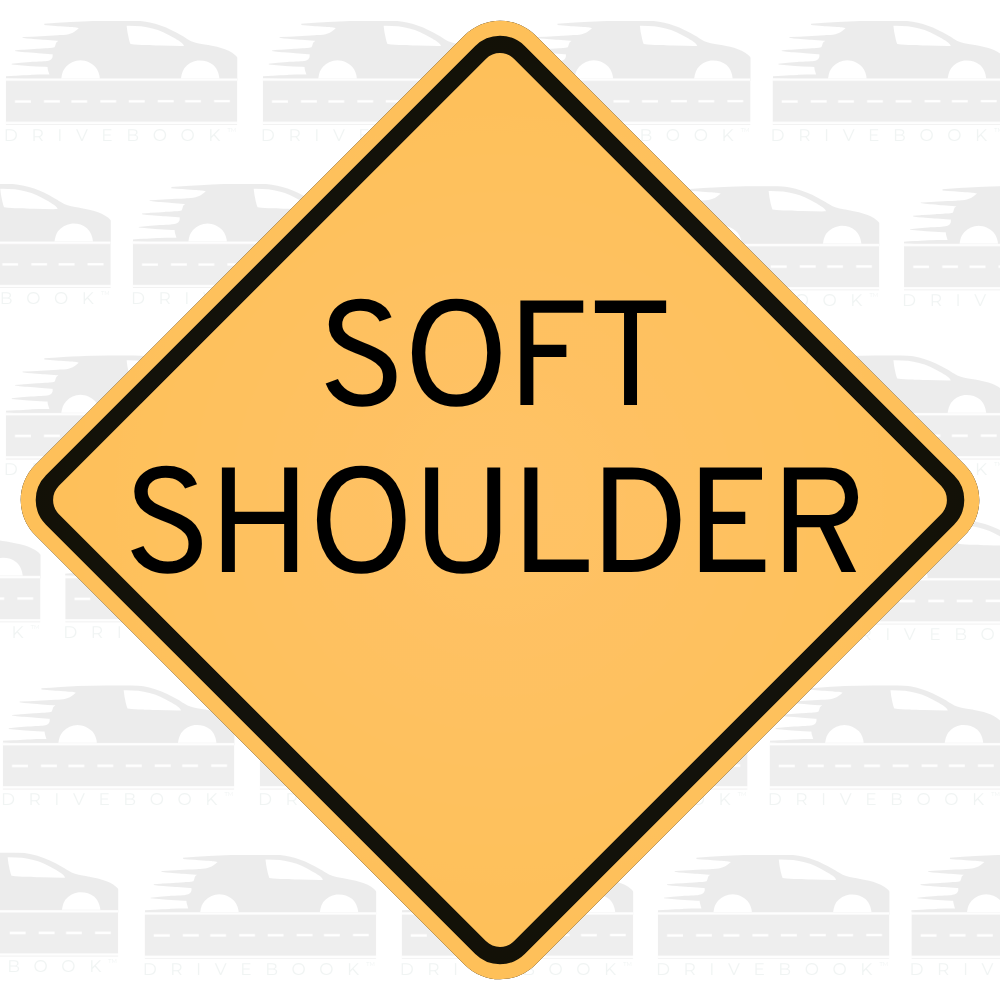
    Everyone needs a soft shoulder to cry on sometimes—thankfully, your car does not. And driving on a soft shoulder can be more dangerous than it looks.

    The Soft Shoulder sign is a warning that the edge of the road (the shoulder) is not as stable or firm as the main driving surface. It might be gravelly, muddy, sandy, uneven, or simply not packed down the same way as the travel lane.

    This sign isn’t telling you that something is definitely wrong. It’s giving you a calm heads-up so you don’t accidentally drift off the pavement and then overcorrect.

    For official U.S. sign standards and usage, the Soft Shoulder sign is covered in the MUTCD’s warning sign guidance: FHWA MUTCD (Warning Signs).


    What “soft shoulder” means in plain language

    A “soft shoulder” means:

    • The shoulder may sink under a tire
    • The edge may be lower than the pavement
    • The surface may be loose (gravel) or slick (mud/wet grass)
    • It may be harder to steer or brake smoothly if you’re partly off the road


    Why this sign exists

    Shoulders are there to give drivers extra space for emergencies, breakdowns, and (in some places) bikes or stopped vehicles. But not every shoulder is built the same.

    A soft shoulder can cause a problem when a driver:
    • Drifts off the edge slightly, then
    • Panics and jerks the wheel back onto the pavement

    That quick “snap back” can lead to loss of control. The sign is there to reduce that risk by encouraging steadier, more intentional driving near the edge.

    For broader roadway safety context and driver behavior resources, FHWA’s safety hub is a credible reference: FHWA Highway Safety.


    🌱 Why this matters even more in the spring

    Soft shoulders can be an issue any time of year, but spring is when road edges can change quickly—sometimes from one week to the next.

    A few reasons:

    • Spring thaw softens the ground
    • More rain increases saturation and instability
    • Freeze–thaw cycles can create uneven edges or drop-offs
    • Road work season introduces temporary surfaces and loose gravel

    So in spring, it helps to treat “Soft Shoulder” as a reminder to drive a little more precisely: stay centered, scan ahead, and avoid last-second steering.


    What you should do when you see this sign

    You don’t need a dramatic response. Think: stay centered, stay smooth, stay aware.

    • Hold a steady lane position (avoid drifting toward the white line)
    • Slow slightly if conditions are wet or visibility is limited
    • Increase following distance
    • Be extra cautious passing cyclists or stopped vehicles

    💬 Coach cue:
    “Let’s drive like the edge is less forgiving here.”


    If your tires drop onto the shoulder

    1. Stay calm and keep the wheel steady
    2. Ease off the accelerator (don’t slam the brakes)
    3. Let the car slow gradually
    4. Check mirrors and traffic
    5. Gently steer back onto the pavement when it’s safe

    Key idea: slow first, then return. Sudden steering is what causes the bigger problem.


    Common misconceptions

    • “The shoulder is basically the same as the road.”
    → Sometimes—but this sign means it might not be.

    • “If I drift off, I should jerk back fast.”
    → Fast corrections can cause skidding or loss of control.

    • “This only matters in rural areas.”
    → It can happen anywhere, especially near construction zones.


    Closing

    A soft shoulder simply means: be a little more precise.

    With calm steering, a centered lane position, and a little extra space, it’s an easy hazard to manage.


    If you want a calm, visual way to learn road signs and rules (and understand the “why” behind them), you can explore Drivebook:
    https://mydrivebook.com


    References

    • FHWA MUTCD (Warning Signs – Part 2C)
    • FHWA Highway Safety

    Share this:
  • Night Driving Basics: What New Drivers Should Know Before the Sun Goes Down

    Night Driving Basics: What New Drivers Should Know Before the Sun Goes Down

    Share this:

    Driving after dark is a different experience than driving in daylight — and that’s not a reason to worry, it’s a reason to prepare. Reduced visibility, headlight glare, and fatigue all play a role in making nighttime driving more demanding. Understanding what changes after dark helps new drivers approach it with awareness and confidence.


    1. Your Vision Works Differently at Night

    During the day, your eyes adjust quickly and take in a wide field of information. At night, that changes. Depth perception becomes harder to judge, peripheral vision narrows, and color recognition is reduced. Headlights on a standard vehicle illuminate roughly 250 feet ahead — which sounds like a lot, but at highway speeds, that’s only a few seconds of reaction time.

    The key takeaway: slow down slightly and give yourself more space to react. You don’t need to be nervous — you just need to be deliberate.


    2. Use Your Headlights Correctly

    Turn your headlights on at dusk — not just when it’s fully dark. Many states require headlights to be on from 30 minutes after sunset to 30 minutes before sunrise, but turning them on earlier than required is always a good habit. It helps other drivers see you just as much as it helps you see the road.

    Use high beams on unlit rural roads when no other vehicles are nearby. Switch back to low beams when you see an oncoming car or are following another vehicle closely. High beams aimed directly at another driver’s mirrors or eyes can cause temporary glare and make driving harder for everyone.

    Bright headlights from oncoming traffic can feel especially intense on two-lane roads or when the road is wet, because light reflects more aggressively off the pavement.


    3. Manage Glare from Oncoming Headlights

    Bright headlights from oncoming traffic can temporarily reduce your ability to see the road ahead. Instead of looking directly at the lights, shift your gaze slightly to the right edge of your lane. This helps you stay oriented without being blinded by the glare.

    If your windshield has smudges or streaks, they scatter light and make glare significantly worse. Keeping the inside of your windshield clean is a simple habit that makes a real difference at night.


    4. Watch for Pedestrians and Cyclists

    Pedestrians and cyclists are much harder to see at night, especially if they are not wearing reflective clothing or using lights. Intersections, crosswalks, and areas near parks or schools deserve extra attention after dark. Slow down when approaching crosswalks and scan both sides of the road, not just directly ahead.

    This is especially important in residential areas where people may be walking dogs, jogging, or returning home in the evening.

    In rural areas, wildlife can become just as important to watch for as pedestrians — especially deer near tree lines and open roadside fields.


    5. Recognize the Signs of Fatigue

    Fatigue and nighttime driving are a common combination — and a dangerous one. Drowsiness slows reaction time in ways that are easy to underestimate. If you notice your eyes feeling heavy, your mind wandering, or yourself drifting in your lane, those are clear signals to stop and rest.

    New drivers should avoid long nighttime drives when tired, especially late at night or in the early morning hours. If you are on a longer trip, plan rest stops in advance and do not push through fatigue.


    6. Build Familiarity Gradually

    If nighttime driving feels unfamiliar, that is completely normal. Start with short, familiar routes in low-traffic conditions. Driving a route you already know in daylight — but at night — helps you focus on adjusting to the lighting and visibility changes without also navigating an unfamiliar area.

    As your comfort grows, you can gradually expand to busier roads, highways, and less familiar routes. There is no rush. Building confidence in stages is a sound approach.


    Night driving is a skill that develops with practice and awareness. Understanding how visibility changes, how to use your headlights properly, and how to manage glare and fatigue gives new drivers a solid foundation before they ever leave the driveway after dark.

    The goal is not to rush into night driving — it’s to let your eyes, judgment, and habits adjust until darkness feels normal too.


    Share this: